

Joe walks the precipice
Mythology and reality meet in stone spirals

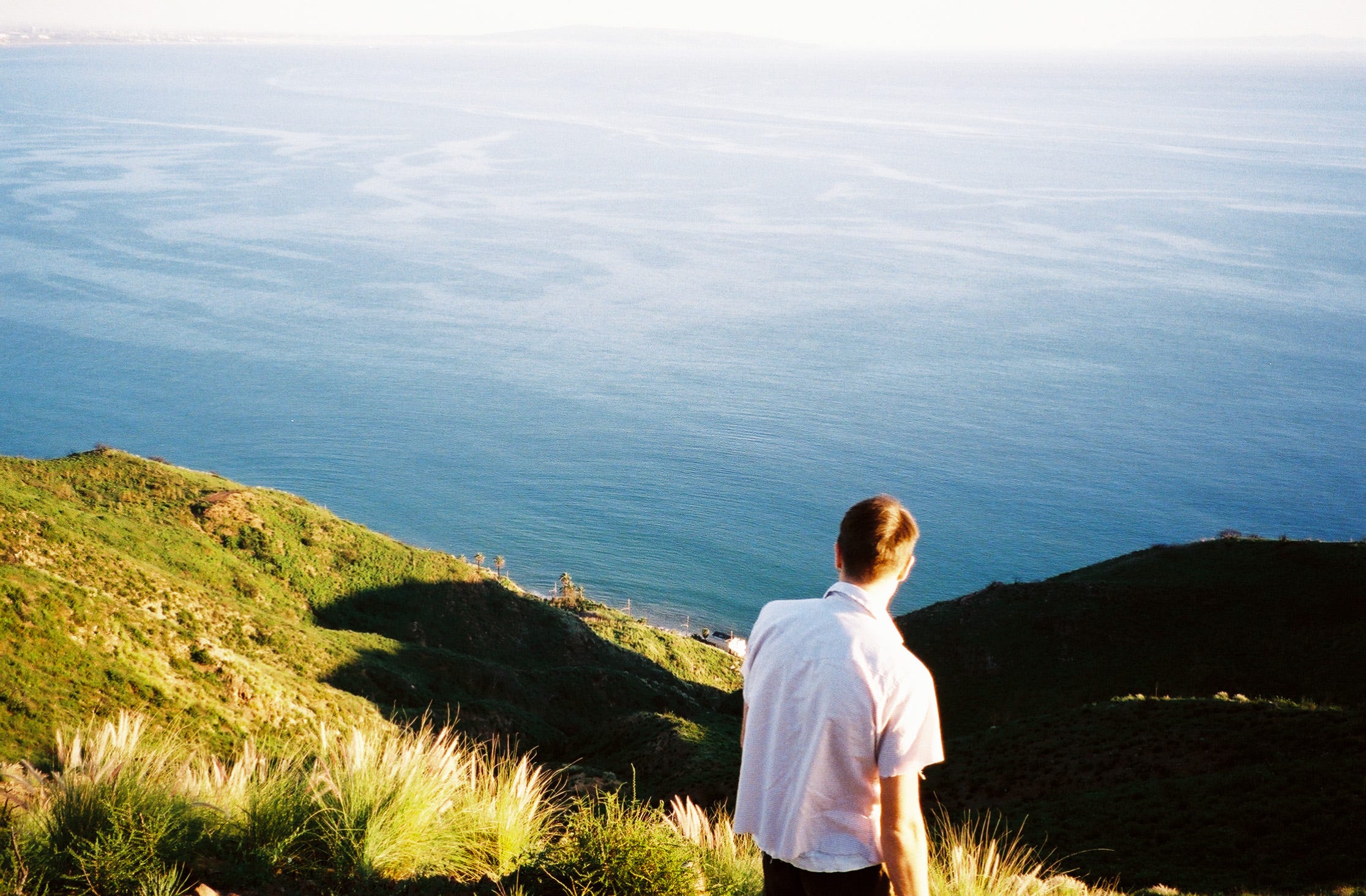
Joe walks the precipice.
He’s built something here, meticulous and foreign, conquistador of stone and path untraveled. Carved his way into a cliffside, leaving behind something semi-permanent, maybe the hardest thing to forge — not easily washed away nor forever embedded into existence. Have you ever created a monument? Have you ever tried?
It’s a Monday when Joe Gutesha picks me up, late afternoon in California’s mixed-signal winter leaving us with three more hours of good light. I offer to meet him halfway but Joe insists, doubling back past his house as we hiccup down the freeway. We stop once for gas and a mini bag of Goldfish before swerving up the canyon road, eating elevation and crunching up brittle orange crackers like we did when we were twelve. We pass the entrance to his adolescent neighborhood home and keep going, Topanga like an outstretched palm.
There goes his old workplace, the gourmet market. There’s the epicurean pizza place, the fire station cautioning Fire Danger HIGH Today! Joe turns right, leading us a notch higher. We weave serpentine under oak canopies. Cottages sit pressed into the hillside with naïve grace, praying for immunity against what Topanga faces every year: fire, flood, landslide. And there’s Joe with that same immunity, fingers crossed, knock on wood. I put a bubble around him in my psyche, every witch in the canyon casting a protection charm around him to ward off danger.
Joe has what a Turkish grandmother would call şeytan tüyü, the devil’s feather. Some innate quality that draws you in, something that makes you want to help them get to where they’re going. It’s not a cunning or deceptive quality like the devil imagery may suggest. It’s closer to purity and charisma, a potion of good intentions and warm passionfruit tea and a spritz of misfortune. If you can help him, why wouldn’t you? I think Joe is often just genuine in a way that’s disarming.
Tuna Canyon’s trailhead is poorly marked and technically gated off. We bypass said gate. The dirt is soft after a week of rain and the grass is shin-high on the path’s fringes, whispering with bugs and snakes, probably. And the sky: open-eyed, cloudless, cushioning the sun as it dips toward the ocean: up ahead.
Joe leads the way, long legs bare from ankle to thigh. A blue hat shields his round nose, green eyes, his straight brown hair. In middle school he wore his hair longer, floppy and boyish. We’ve known each other longer than we haven’t known each other.
What we’re heading toward has been a surprise kept hush for a month. Joe has only been calling it his “project,” leaving me to imagine some sort of wilderness art installation, colorful and decorated with words. He’s a writer, after all, a polyglot poet chipping away at an epic about people intertwining in another era, worldbuilding and decoding his own creations for the past few years in a handful of languages (he speaks around six). He’s giving a lecture on narrative and worldbuilding at a local college this week, his secret project at its core.
On the path, the road forks. If memory serves, this was Joe’s first hike as a child, four years old in his hiking sneakers, and this fork has remained his reference point of left and right ever since. It appears in his mind’s eye whenever he’s given directions.
He asks me to pick which way we go. I know we have a destination, so in theory and in practice there is a right and wrong way. To the left is a hill, steeper than I would like to climb. To the right, the road remains flat. The ocean is in view to the right, among the green expanse of fields and light.
“I feel like we might have to go left up the hill, because it’s what I’d rather not do,” I say. “But I’d really like to go right.”
“What do you think I’d say you should do?” Joe counters.
“You’d… say I should do what I feel called to do… and should trust myself,” I tread. “So we should go right?”
He’s pleased.
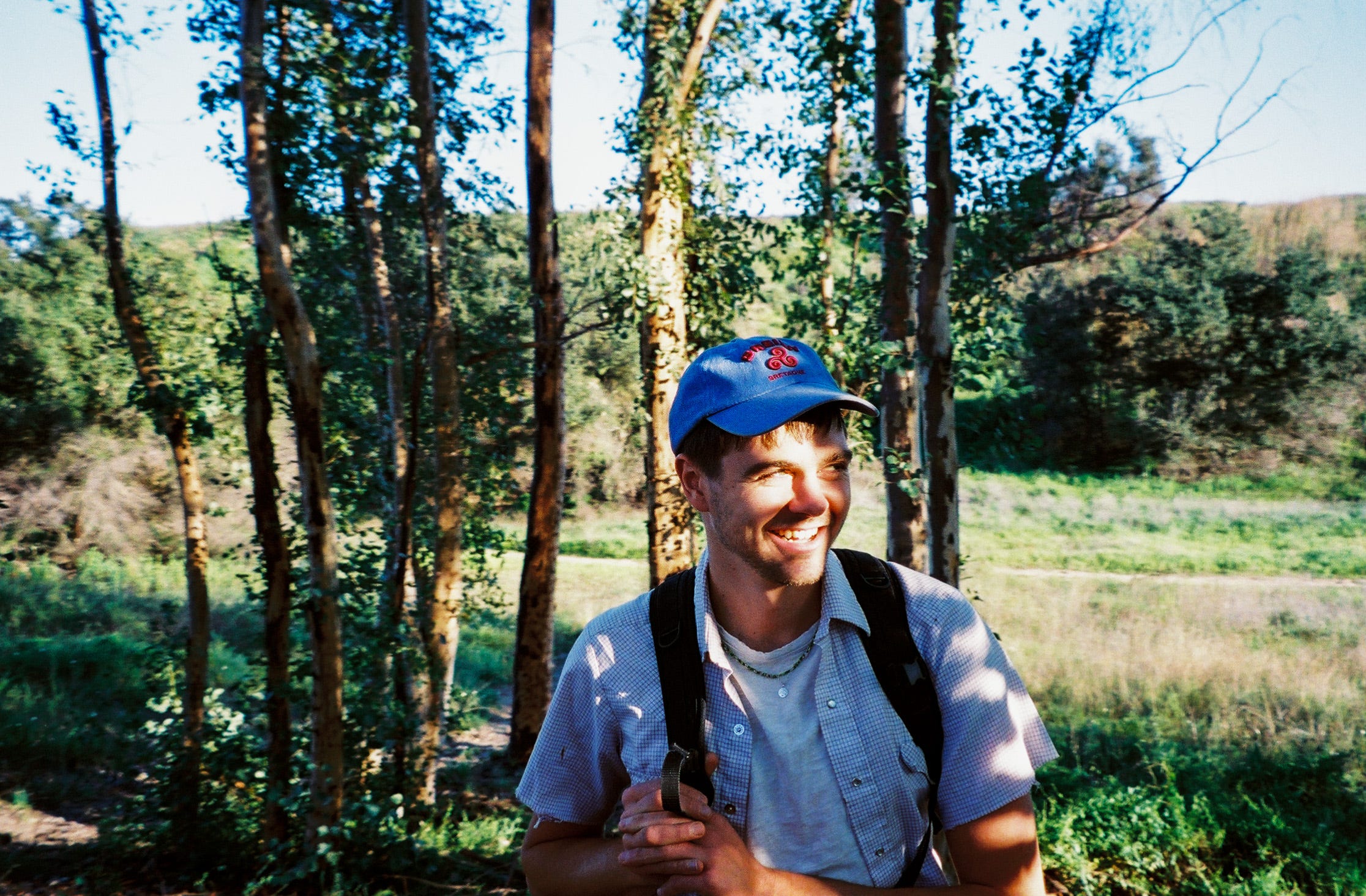
The trail splits and splinters so many times in the maze of Tuna Canyon that it doesn’t lead anywhere in particular, but there’s a point where the specific dirt path we’re following turns back into rock and weed and then I’m truly at the whim of Joe’s intuition to lead the way. He’s been coming to this exact spot for a couple months so it’s easy to place my full faith in him. The sun will set in close to an hour.
Then we’re at The End. Cliffside. Tall grass punching through rocky earth, almost volcanic.
Joe calls this mesa God’s Eye.
“Something about being right here feels like everything is seen,” he says, eyes scoping the horizon. “And yet also I feel like I’m in utmost privacy.”
A few hills roll out ahead, exposing scar tissue from the fires last year. Spread out to the south is the sprawl of Los Angeles’ cityscape, its skyline breaching smog. To the west of the precipice is pure ocean.
We’re here for the mesa’s centerpiece: a stone spiral, a labyrinth. One Joe has been coming here to build for more than a month.
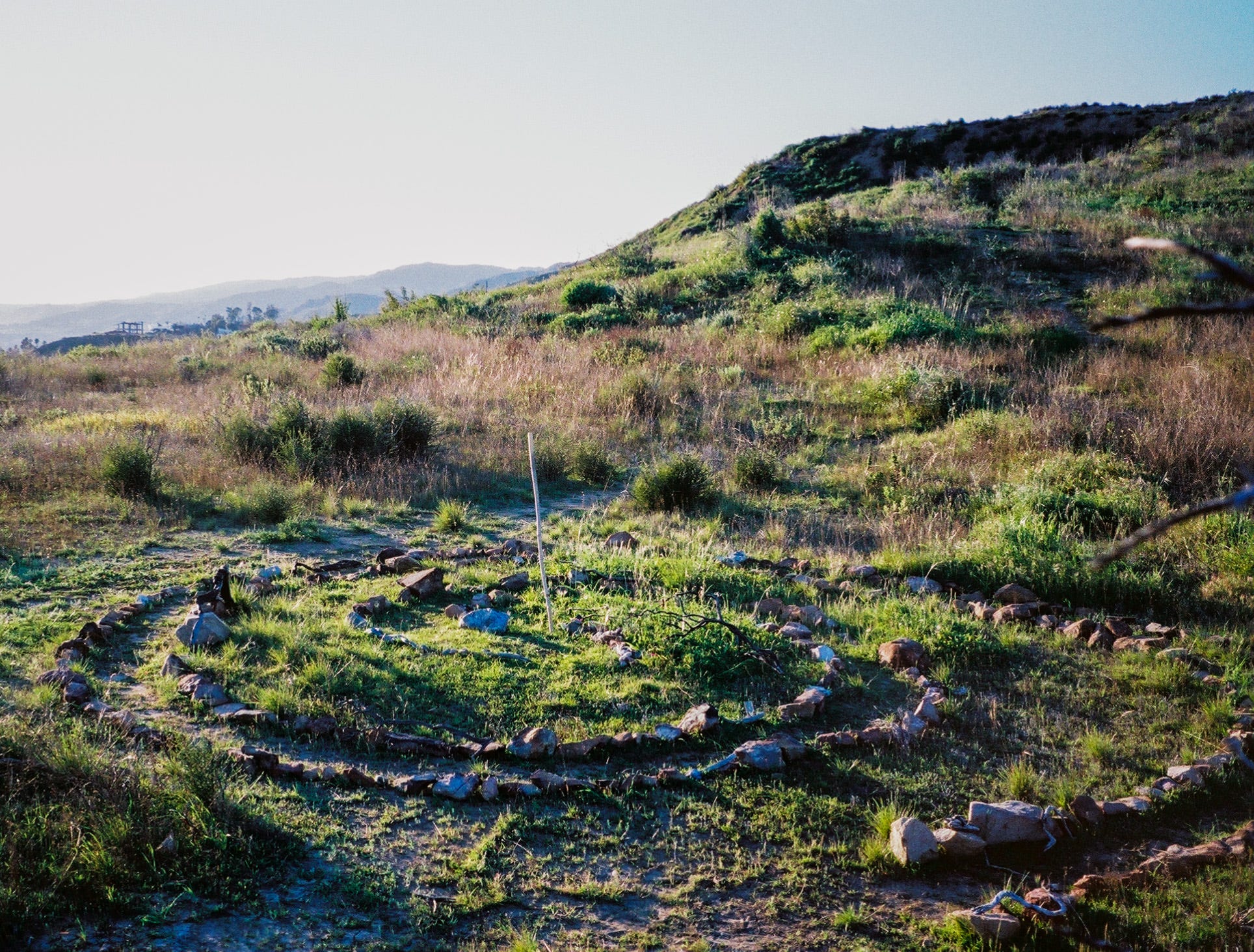
“I knew I wanted a project for the new year,” he says. We’re sitting on boulders overlooking the labyrinth. “I didn’t realize what the undertaking would be until I picked up some stones. It was around this time of day that I was here, so I didn’t have a lot of daylight left, but I just collected a few stones, maybe ten or twenty, and built the first curve.”
He worked meticulously but not scientifically, letting the stones determine the outcome, measuring with his eye alone. He built the spiral from the outside in, never undoing his work. Everything placed stayed.
Joe collected rocks from all over the mountainside, finding different colors on different ridges. He accumulated some rusted metal rods and shards of glass. When rain muddied his progress, he still loped across the landscape, unhurried, blinking dew from his lashes. When he ventured down to one mesa about a half a mile below, he laid on his back and let the earth serve as a cushion. Some days a thick silver duvet of marine layer draped itself over the ocean. The mesa sat above it all. God’s eye.
“It’s like a puzzle that had no rules,” Joe says. “I would just put a rock next to each other. I never had to think about, well, of all the rocks, which was the next best one? There was nothing for me to evaluate in terms of why this rock shouldn’t be the one that goes next.”
“Yeah,” I nod. “You don’t have to complicate it, you know?”
“No, I didn’t have to complicate it. I don’t even know what that complication would serve. Like, could the labyrinth be better? Better in what way? If I had placed every rock in what order?”
“Well, that’s the trouble with perfectionism, because people do think like that.”
“Yeah, I would never finish,” he says. “The whole point was to have fun doing it.”
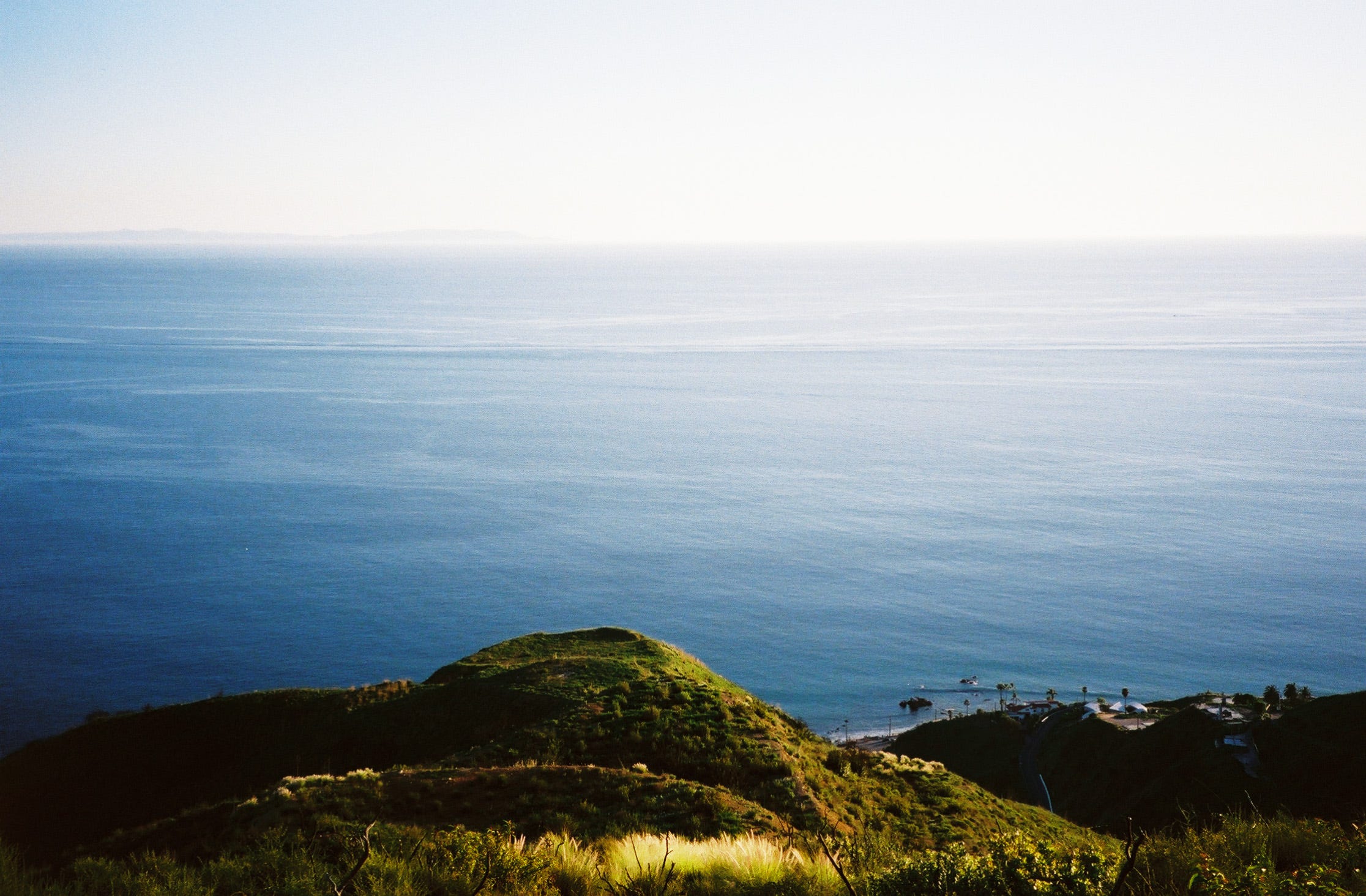
When Joe would tell people about the labyrinth project, they would marvel over the fact he was doing something for pure fun, with nothing to be gained nor lost. He felt like a kid again, exploring and digging up red earth with bare hands.
“It’s refreshing to do that, to be outside and to be alone,” Joe continues. “As much as it feels like fluff, I feel like it’s also the most important thing I could do as a sentient creature with this existence where, more often than not, I feel robbed of the presence that is just being alive. Dealing with the blizzard of your own thoughts — out here it doesn’t feel like any of that has real value.”
In high school I’d see Joe sporadically, once on my birthday, once for some escapade in the canyon: Joe driving with the windows down in the rain, with the windows down in dead heat slicing toward the beach. One New Year’s we watched fireworks over the ocean. While we sat in stand-still traffic on PCH Joe popped out of the driver’s seat to pick wildflowers from the median. Another year we drank persimmon nectar from a roadside restaurant and then laid in a field, summer bugs humming in our ears.
This was all before Joe left California, before those wayward years he lived in New York, before the year we didn’t talk, before he lived in Japan. He’s wandered four out of seven continents. Stories from his life often resemble a magical realism novella, full of wild boars in French forests or finding his way through Kyoto with a vocabulary of spells. Now we have California to share until he’s called to his next quest, fingers crossed for Uruguay. He embodies spontaneity with measure, born thoughtful and a little impulsive. Things do tend to work out for him, but there’s a tightrope quality to his days. I’ve never seen fear stop him from doing anything.
“These are my stomping grounds, right?” Joe muses. “I’m making my own architecture out here, leaving my own imprint. I grew up on these trails, passing these labyrinths and following them, and leaving my own little objects when I could.”
Joe is weaving the architecture of his life. How eagerly the rest of us want to walk the spiral. He’s a storyteller, blessed with both that proclivity to share some bizarre and poignant tale and to charm his rapt audience with the story.
I think the most achingly essential part of Joe is he’s always on the move. He wants you to go with him, but he’ll go alone. And if you ask him what he thinks, he’ll always tell you.
It was a form of meditation, the stone picking, both active and passive. He’d get into a groove. Sometimes he’d show up to the mesa feeling overtaken by some emotion, needing to rid himself of it before working. Standing against the view is a small boulder beside an upright yucca, a lone stem stretching to the half moon above us. It’s where he would sit to ground himself before entering his labyrinth.
I try to find the origin of the word labyrinth, assuming some Greek patchwork etymology, but it predates Greek. There isn’t a consensus on how the word came to be.
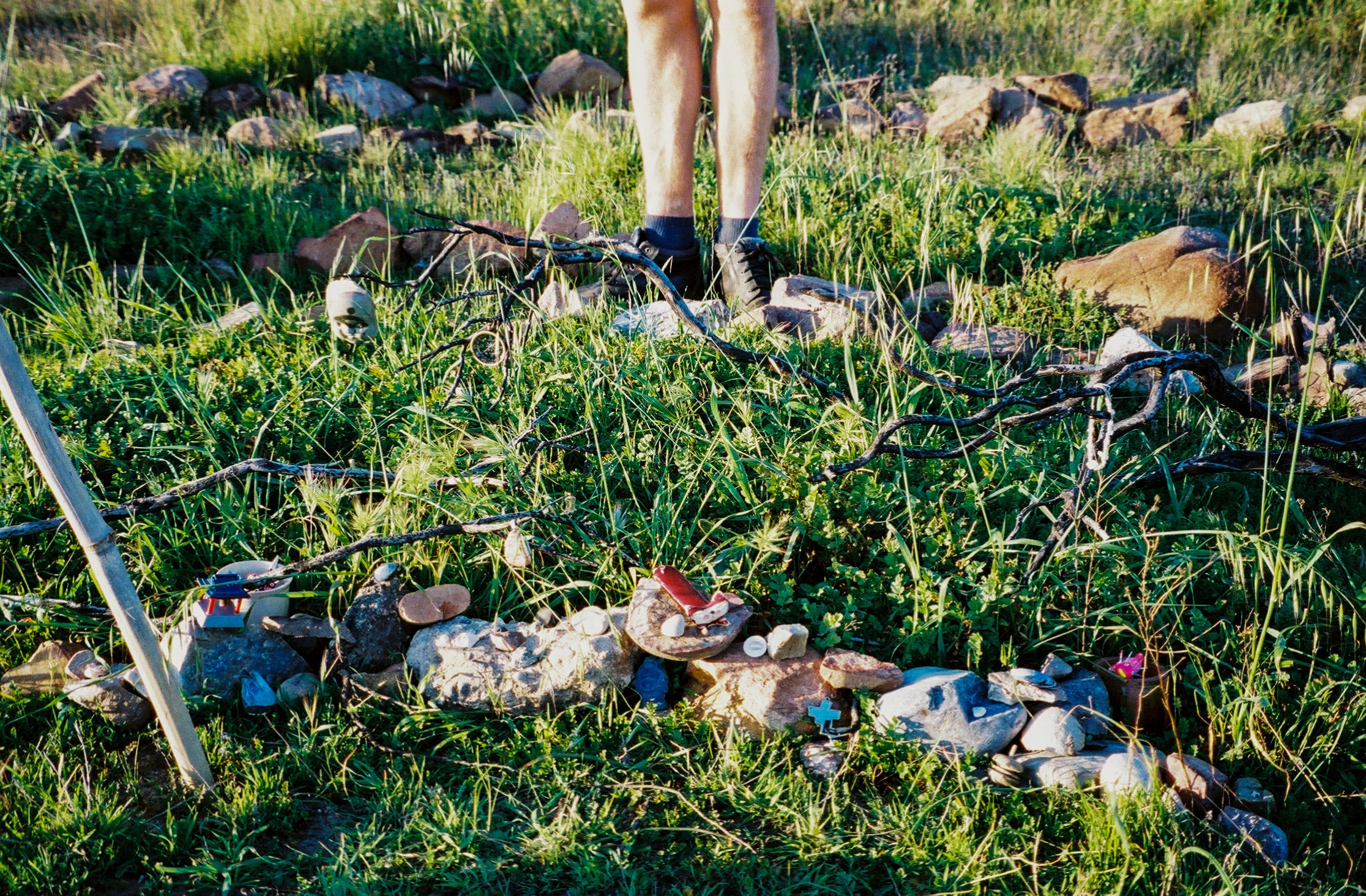
In the center of the spiral are Joe’s treasures, tchotchkes he’s collected over the years. Most are gifts from other parts of the world, from Mexico, Japan, Korea, New York. Some lay scattered, others deliberately placed. A carved octopus, a red ceramic fox, a marble, shells, crystals, a plastic miniature Japanese shrine, an axolotl painted bright pink, a baby doll’s pale head. A gnarled hunk of wood resembling an anatomical heart, found on the trail, perches in the center.
The objects represent memories, even those that aren’t his. They come from friends and lovers and strangers. They’re guarded by the twisting stone path.
On another ridge in these mountains is a time capsule, buried by Joe and his brother right before Joe moved to New York. When they submerged it, Joe felt like it was the safest place he could keep anything.
He hasn’t had a rooted home base in a while. His family migrated out of Topanga a few years ago, scattering around the state. Since then he’s lived abroad or with friends, always ready to gather his things and move into another guest room.
“I’m constantly taking all my stuff, losing it, leaving it, spreading it out,” he says. “I’m impressed by any of the things I managed to hold on, because I grew up being someone who would just forget everything and have to accept, well, that’s gone forever. But these items, in some ways, are safer out here. They’re part of the natural terrain.”
We’re crouched in the center of the spiral when he notices a pouch he’d placed there is gone. Joe searches among the stones for it, lamenting its swiping from the scene before conceding the loss. I imagine some coyote nudging its snout among the objects, picking the pouch for its scent and soft fabric and taking it back to its trove in the hills. (Likely not, but let’s pretend.)
“Nature will have its way with them,” he says of the objects. “I think that’s also what happens in my own psyche. You can’t forge ahead, carrying the same significance of things forever. Time wears or changes it.”
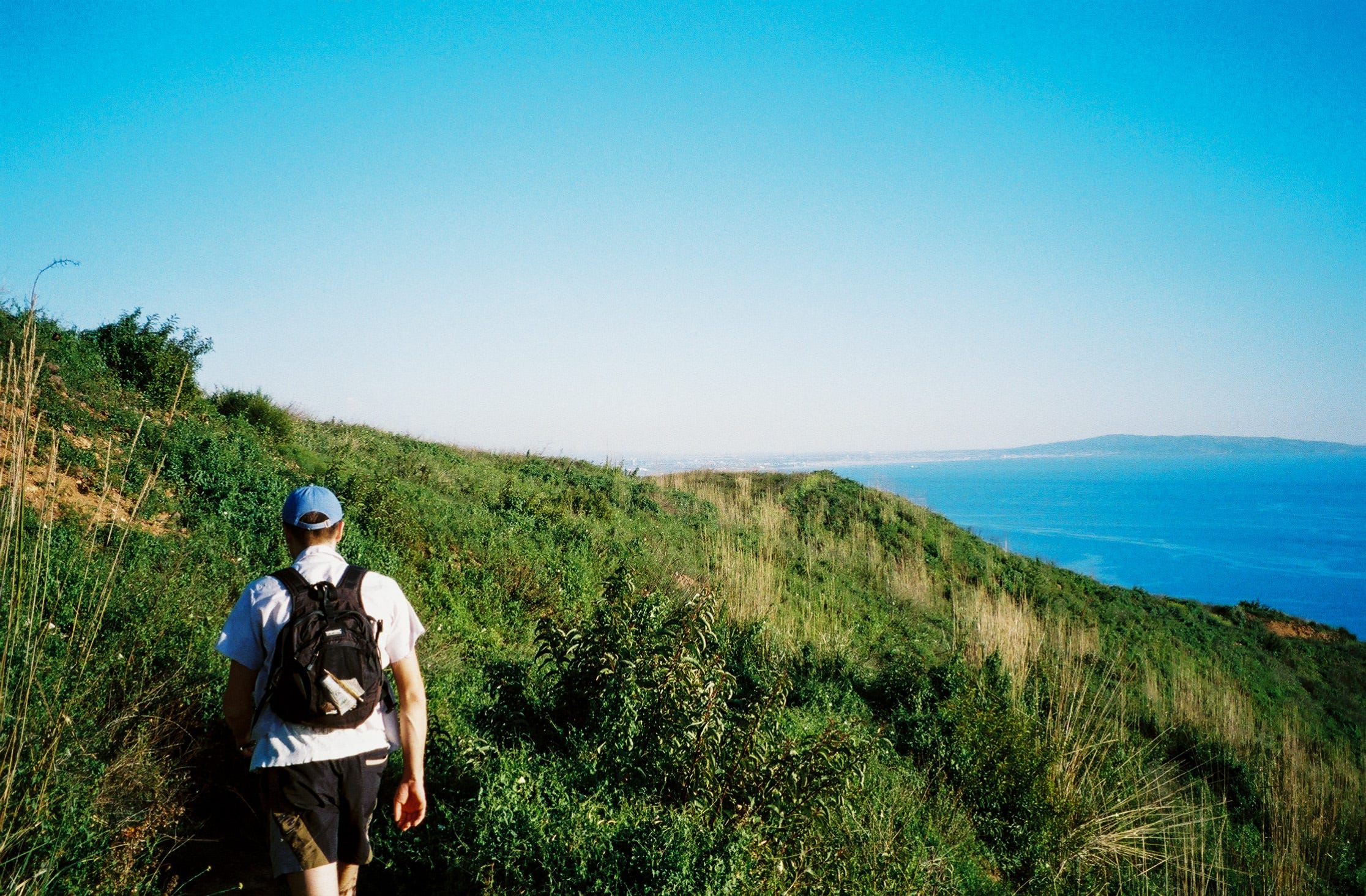
Mythically, you get lost in a labyrinth. Joe allowed himself to get lost while making his.
“There’s nothing more symbolic than building a path that doesn’t really go anywhere,” he says solemnly. “But the whole point of it is you’re not transported anywhere except maybe to another state of mind.”
The labyrinth was a project to mark the new year. Joe says the piece “speaks to the mythology of what can happen next.”
“There are times when building it was this metaphor for the entire world,” he says.
“We’ve built a labyrinth of this planet. Our lives are so convoluted, and deciphering what is meaningful and what is not, or what is important to you and what is not — these are all labyrinth questions.”
He looks at what he’s built, a place for hikers to find and follow. It’s funny calling it a labyrinth, he says, because ultimately, it’s a single path that spirals into the center.
It’s already lapsed into anonymity. No one coming across it knows Joe Built This, instead seeing it as something that Has Been Built. Passive voice.
Maybe he’ll never build another labyrinth, but the rendezvous with his untapped childlike wonder unearthed new potential. Joe says he feels, more than ever, the pitfalls of the imagination alone. In the labyrinth, outside with fresh air, the open sky, the ocean, his hands in the dirt, everything felt “very real and carnate.”
“This will probably be here forever,” I say.
“I can’t see why it wouldn’t,” he says.
The sun’s belly sinks below the surface of the ocean. We hike back. Joe is talking about understanding and communication. His legs are longer than mine, he’s getting further away. I can barely hear him.
Before we reach the Tuna Canyon gate, he says he’s always sad to leave. Sad, he says, when it’s time to venture back into the big labyrinth.
The coordinates of the labyrinth are 34.045, -118.607.
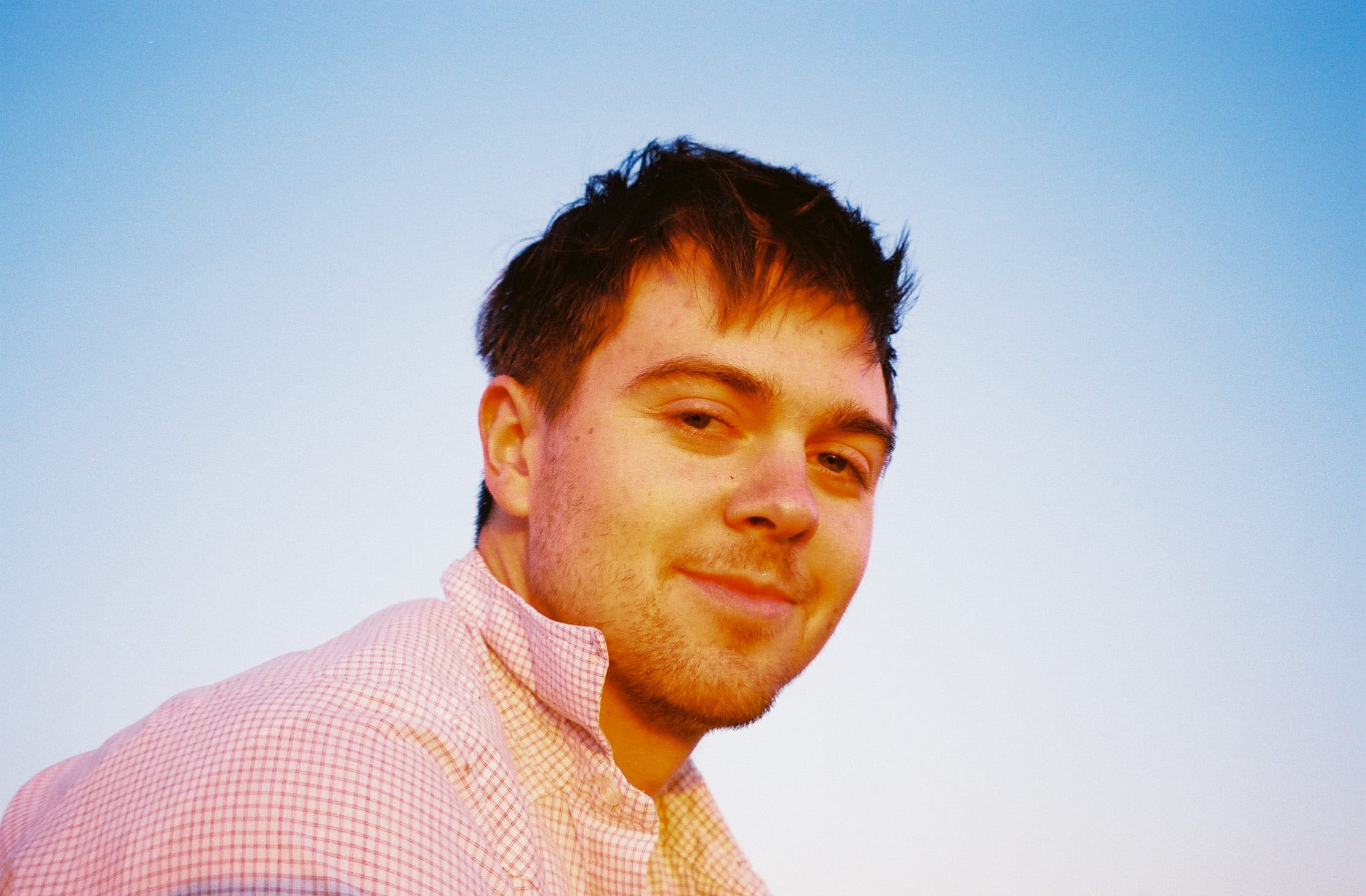
Find Joe Gutesha bounding about in Topanga Canyon. He writes at Jlaudio’s Extraordinary Café. You can read his piece on the labyrinth project here.
First Name Basis is Izzy Sami’s bridge between journalistic integrity and personal relationships, pushing the definition of “conflict of interest.” Profiles of people she meets out in the world are published once a month, twice a month if she gets a grip on her time management, and not at all if her subject ghosts her.